Monday, February 21, 2011

Reasoned Faith: Cosmological Arguments Part I


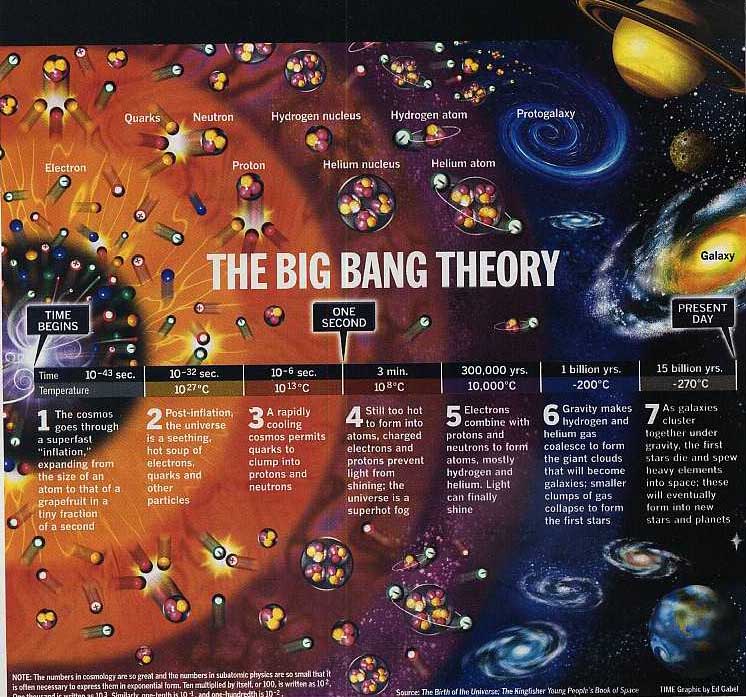
Modern cosmology has shown that the universe had a very hot infancy, and that it has been expanding and cooling for the past 13.7 billion years. Astronomers have found incontrovertible evidence supporting the big bang model, in the form of a widespread radiation that permeates space, a relic of the cosmic hot and dense past. We can confidently reconstruct the cosmic history from about a second after the "bang" onward, not too bad-- Marcelo Gleiser, Theoretical Physicist at Dartmouth College.
Cosmological arguments have been around for hundreds of years, but recent scientific discoveries have given these arguments more force. The big bang model shows that the universe had an origin 13.7 billion years ago. This evidence fits perfectly with William Lane Craig’s Kalam Cosmological Argument:

   Premise 1--Whatever begins to exist has a cause of its existence.

   Premise 2--The universe began to exist.

   Therefore-- the universe has a cause of its existence.

Prior to the big bang time, space and the physical constants did not exist. The building blocks of matter had yet to be formed. Since there were no material building blocks prior to the big bang and we know that the universe had an origin 13.7 billion years ago we know that the universe had to have some sort of cause and that the universe began to exist. This argument drives us to search for what caused the universe to come into existence.

Saturday, February 19, 2011

Evidence of Atheist Delusion?

These Christians think all skeptical arguments are utterly lame, including mine. Who in their right mind would think this? Just once I'd like to hear a devout Christian say something like: "Hey, that's something I haven't thought of before," or, "This is a serious problem for my faith." It's just that these things are almost never said. No, they have the answers. And they laugh at all skeptical arguments, many of which derive from David Hume, who is thought to be the greatest English speaking philosopher who ever lived.
Now it's one thing to disagree with the skeptics. It's another thing entirely to think our arguments have no force at all. The fact that most Christians think they have no force at all simply means these Christians are delusional--John Loftus.


John Loftus of the Debunking Christianity blog has been lamenting the pushback he has been getting from believers who aren’t bowled over by his arguments. Since he is an ex-Christian I’m amazed that he doesn’t grasp the fact that theists and atheists have been locked in a stalemate for hundreds of years. Both sides have intelligent people with decent although imperfect arguments. Both sides seek absolute proof that God exists or doesn’t exist, proof that, at this point, doesn’t exist. I’m amazed that atheists like him can’t see that atheism is the mirror opposite of theism, that atheism is a belief that requires faith.

To a certain extent I agree with John that some atheist arguments like the problem of evil, the Santa Principle; and John’s Outsider Test for Faith do have some force, but I disagree that they prove that God doesn’t exist. The best atheist arguments show that it is possible that God doesn’t exist just like the best theist arguments show that it is probable that God exists. Since both sides are in a stalemate it comes down to whether you believe that God exists or that he doesn’t exist or that we don’t have enough information to know whether He exists.

Friday, February 18, 2011

Bridging the Divide Between Faith and Science

Last week on the 13.7 blog there was an emphasis on the conflict between faith and science. In one entry Adam Frank posted a video from Bill O'Reilly where O'Reilly is claiming that God created the moon. In Frank’s post and a follow up post he questions which explanation, the scientific or religious, for the origin of the moon requires more faith. I’m no fan of O’Reilly but I think he is partly right and Frank is partly right. Couldn’t God have orchestrated the formation of the moon via the natural processes that science has discovered?


The leading scientific theory for the formation of the moon is that when the earth was still very hot a large object about the size of mars collided with the earth causing a rocky debris to blow out from the earth. Gravity caused this debris to orbit around the earth and coalesce into a ball that became the moon. One of the main reasons why scientists support this hypothesis is because the oxygen isotope composition of the earth is identical with moon whereas the composition is different than rocks from mars and meteorites. I think this is a very plausible explanation for how the moon was formed.

Friday, February 11, 2011

Quote of the Day, by Philip Hefner

For those of us who begin with God, the challenge is to recognize that our scientific understandings of nature are revelation – revelation of what God has done, what God is doing now, and what God intends.

Negating the Negations: Smith’s Logically Impossible God Argument

In his book “Atheism: The Case Against God” which was Published in 1980 George H. Smith attempts to prove that God is logically impossible. His main argument can be formulated as follows:


Premise 1 -- The universe and every entity behave in accord with natural law ("uniformity of nature").

Premise 2 -- Natural law is determined by the limited nature of existence.

Premise 3 -- Existence is limited in that every entity has a specific nature, determinate (finite) characteristics, that determine the capacities of that entity.

Premise 4 -- Whatever does not have finite characteristics does not exist.

Premise 5 -- A supernatural being does not have finite characteristics

Therefore -- A supernatural being does not exist.*

Premise three is fallacious because it begs the question that all entities are finite. Entities that exist in the physical world such as the universe, the sun, humans and animals do have finite characteristics because they are composed of parts that can break down. The sun and the universe are subject to the second law of thermal dynamics and so will eventually be extinguished. You and I are subject to the breakdown of our organs and the mutation of our DNA. However, by definition God is an eternal, spiritual being that is not composed of parts and is not subject to finite characteristics. As a spiritual being God is outside of the limits of natural law which he created.

Monday, February 7, 2011

Google Art Project: A Great Tool for Art Lovers

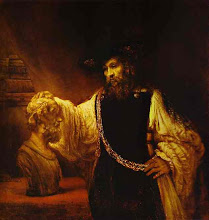
I recently found out about the Google Art Project in the Washington Post and New York Times, and thought it was one of the coolest things I’ve seen in a while. Google is now using their street view camera inside some of the world’s great art museums such as The Metropolitan Museum of Art, the Hermitage, and the Van Gogh Museum so that people can take virtual tours of the museums. Sadly, the Louver is not on the list, but hopefully it will be one day. The resolution of the museum view camera is not very high, but taking virtual tours from your laptop is still pretty amazing. My favorite feature of the Google Art Project is the collection of famous pieces from each museum that can be zoomed in on in ultra high resolution. You can zoom in so closely that you can literally see the brush strokes. It’s like the art work is right in front of your face. Naturally, Aristotle with a Bust of Homer by Rembrandt was one of my favorites.


Besides adding more museums it would be nice if Google could add piece descriptions to their zoomed in collection. Higher resolution views for the museum tour would also be nice. However, I think Google has a good start with their Art Project. It’s a great tool that brings art lovers and the object of their affection a little bit closer.

Tuesday, February 1, 2011

Quote of the Day, by Dietrich Bonhoeffer

“A God who let us prove his existence would be an idol.”